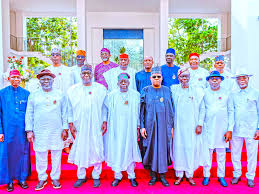
A silent but fierce political struggle is unfolding within the ruling All Progressives Congress ahead of the 2027 general elections, as President Bola Tinubu and powerful state governors battle for control of the party’s National Assembly tickets.
What initially appeared to be routine consultations over the conduct of party primaries has rapidly evolved into a wider power contest capable of reshaping the APC’s internal structure and determining the future balance of influence within the ruling party.
At the centre of the unfolding conflict is the compilation of the APC’s final list of candidates for the Senate and House of Representatives — a process regarded as critical to the survival of Tinubu’s political dominance ahead of 2027.
Presidency insiders disclosed that concerns have been mounting within the Villa over growing attempts by governors to take complete control of the nomination process in their respective states.
In response, Tinubu was said to have approved the establishment of a high-level political committee made up of the APC National Chairman, the Chief of Staff to the President, the Special Adviser on Political Affairs and key political strategists to engage governors and protect the interests of federal lawmakers considered loyal to the administration.
Sources familiar with the arrangement said the committee was specifically designed to prevent the wholesale displacement of serving senators and House of Representatives members who have consistently defended the President’s Renewed Hope Agenda in the National Assembly.
The move reflects deepening anxiety within the Presidency that governors may use their overwhelming control of state party structures, delegates and congresses to install loyalists while sidelining lawmakers perceived to be closer to Tinubu than to local political blocs.
Although the APC leadership has repeatedly pledged to conduct transparent primaries, developments in several states have already triggered allegations of manipulation, imposition and monetisation of the process.
Within party circles, many now believe the APC’s biggest political battle ahead of 2027 may not come from opposition parties, but from the escalating supremacy contest between the Presidency and governors over control of the party structure.
Multiple party sources revealed that governors are intensifying efforts to dominate the National Assembly nomination process because of the strategic importance of legislative control in future power negotiations within the APC.
Several governors are believed to be uncomfortable with lawmakers who maintain direct access to the Presidency and operate independently of state political structures.
This has heightened fears among serving lawmakers, many of whom now worry that securing return tickets may depend more on loyalty to governors than on legislative performance or support for the President.
The tension has sparked intense lobbying within the APC National Working Committee, where competing interests are reportedly pushing conflicting agendas over the final approval of candidates.
Confusion has also emerged over who possesses the authority to officially declare winners of the primaries — the APC National Working Committee or state party structures heavily influenced by governors.
In some states, parallel directives and unofficial candidate lists have reportedly surfaced even before ratification by the party’s national leadership, worsening uncertainty within the APC.
The development has further exposed the complex power dynamics within the ruling party, where governors appear to control the grassroots machinery while the Presidency seeks to retain strategic influence from Abuja.
Political observers say the unfolding confrontation could become a defining test of Tinubu’s authority as leader of the APC.
For years, Tinubu cultivated a reputation as one of Nigeria’s most influential political tacticians, building alliances, controlling party structures and installing loyalists across different levels of government.
That political network played a decisive role in his emergence as President in 2023 and cemented his standing as the APC’s central power figure.
However, recent developments suggest some governors may now be seeking greater independence and leverage within the party as permutations for 2027 gather momentum.
Analysts believe the battle over National Assembly tickets goes beyond ordinary political ambition.
According to insiders, whoever controls the APC’s legislative candidate list ahead of 2027 could ultimately shape the party’s future leadership structure, influence federal policymaking and determine the alignment of forces ahead of the next transition cycle.
“This is not just about tickets,” a senior APC source said. “It is about control of the party and the future direction of the APC after 2027.”
The growing uncertainty has already triggered quiet alignments among senators, House members and influential stakeholders anxious about the outcome of the primaries.
Some lawmakers are reportedly considering legal action should the process be perceived as compromised, while others have intensified consultations with top party figures in Abuja.
Within the APC National Working Committee itself, there are indications of mounting pressure from rival camps.
While some party officials are believed to favour governors because of their influence over state structures and party financing, others are pushing for a balanced arrangement that protects lawmakers loyal to the Presidency.
Observers warn that the conflicting signals emerging from state chapters and the national leadership risk deepening internal divisions within the APC at a sensitive political moment.
The stakes remain particularly high because control of the National Assembly is central to Tinubu’s ability to sustain legislative backing for his administration’s economic and political agenda.
A fragmented or hostile legislative caucus could complicate policy-making and weaken the President’s influence within the party ahead of the next election cycle.
For governors, however, securing dominance over National Assembly tickets represents an opportunity to consolidate their political structures, strengthen their negotiating power and expand their influence nationally.
As consultations continue behind closed doors, the APC’s final candidates list has become one of the most closely watched political developments ahead of 2027.
Across the country, party loyalists, aspirants and political observers are waiting to see whether Tinubu can still impose his authority on the ruling party or whether governors have emerged as the new dominant force within the APC.
The outcome of the struggle may not only determine who secures the party’s National Assembly tickets, but could also redefine the future balance of power within the ruling party for years to come.
For now, the battle remains unresolved, the negotiations continue quietly, and the suspense deepens within the APC.
Culled from This Nigeria